

The Department of Mathematics, Faculty of Mathematics and Natural Sciences (FMIPA), Universitas Syiah Kuala (USK), organized a Public Lecture on Actuarial Mathematics entitled “The Contribution of Actuarial Science to Disaster Mitigation and Management” on June 19, 2026, at the FMIPA USK Theater Hall. The event featured Danang Teguh Qoyyimi, S.Si., M.Sc., Ph.D., a faculty member from the Department of Mathematics, Faculty of Mathematics and Natural Sciences, Universitas Gadjah Mada (UGM), as the keynote speaker.
The public lecture was held to broaden the perspectives of students and faculty members on the role of actuarial science in addressing disaster-related challenges. Through the application of mathematics, statistics, and risk analysis, participants gained insights into how actuarial science can make meaningful contributions to disaster mitigation policies, risk management, and sustainable disaster financing systems.
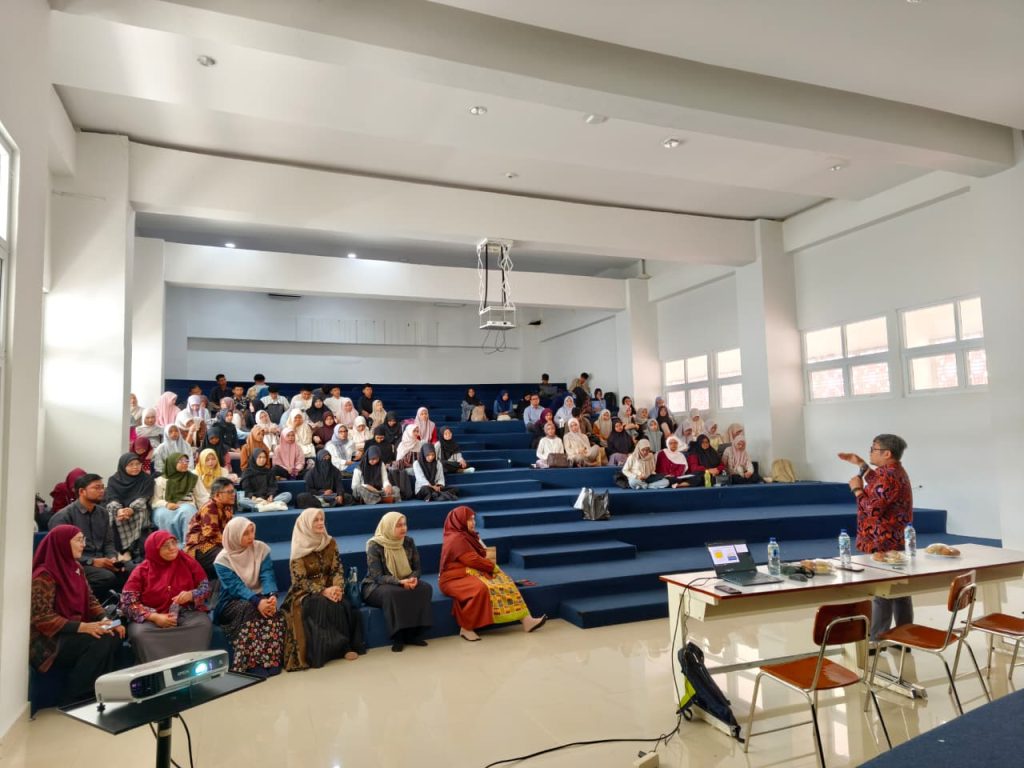
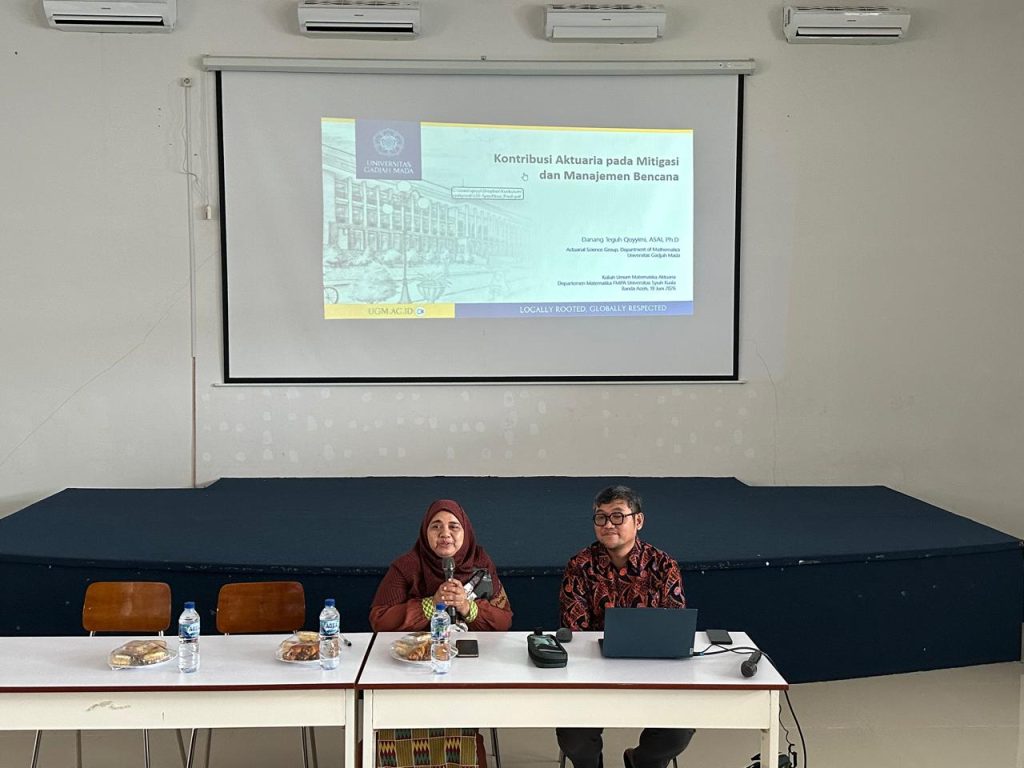
The Department of Mathematics, Faculty of Mathematics and Natural Sciences (FMIPA), Universitas Syiah Kuala (USK), organized a Public Lecture on Actuarial Mathematics entitled “The Contribution of Actuarial Science to Disaster Mitigation and Management” on June 19, 2026, at the FMIPA USK Theater Hall. The event featured Danang Teguh Qoyyimi, S.Si., M.Sc., Ph.D., a faculty member from the Department of Mathematics, Faculty of Mathematics and Natural Sciences, Universitas Gadjah Mada (UGM), as the keynote speaker.
The public lecture was held to broaden the perspectives of students and faculty members on the role of actuarial science in addressing disaster-related challenges. Through the application of mathematics, statistics, and risk analysis, participants gained insights into how actuarial science can make meaningful contributions to disaster mitigation policies, risk management, and sustainable disaster financing systems.
In the opening session, Dr. Danang introduced the fundamental concepts of actuarial science and the scope of the actuarial profession. He explained that actuarial science integrates mathematics, statistics, economics, finance, and risk management to analyze uncertainty, particularly financial risks. In practice, actuaries play a vital role in designing insurance products, managing financial reserves, and developing risk financing strategies.
The speaker also introduced the Actuarial Control Cycle, a professional framework consisting of four key stages: identifying the problem, designing the solution, implementing the solution, and monitoring the results. He emphasized that each stage is influenced by external factors such as economic conditions, government regulations, technological developments, and public policies.
One of the main topics discussed during the lecture was the contribution of mathematics and actuarial science to Disaster Risk Financing and Insurance (DRFI). Participants were introduced to various quantitative methods used in disaster risk financing, including ratemaking, financing optimization, and simulation-based optimization for managing disaster pooling funds.
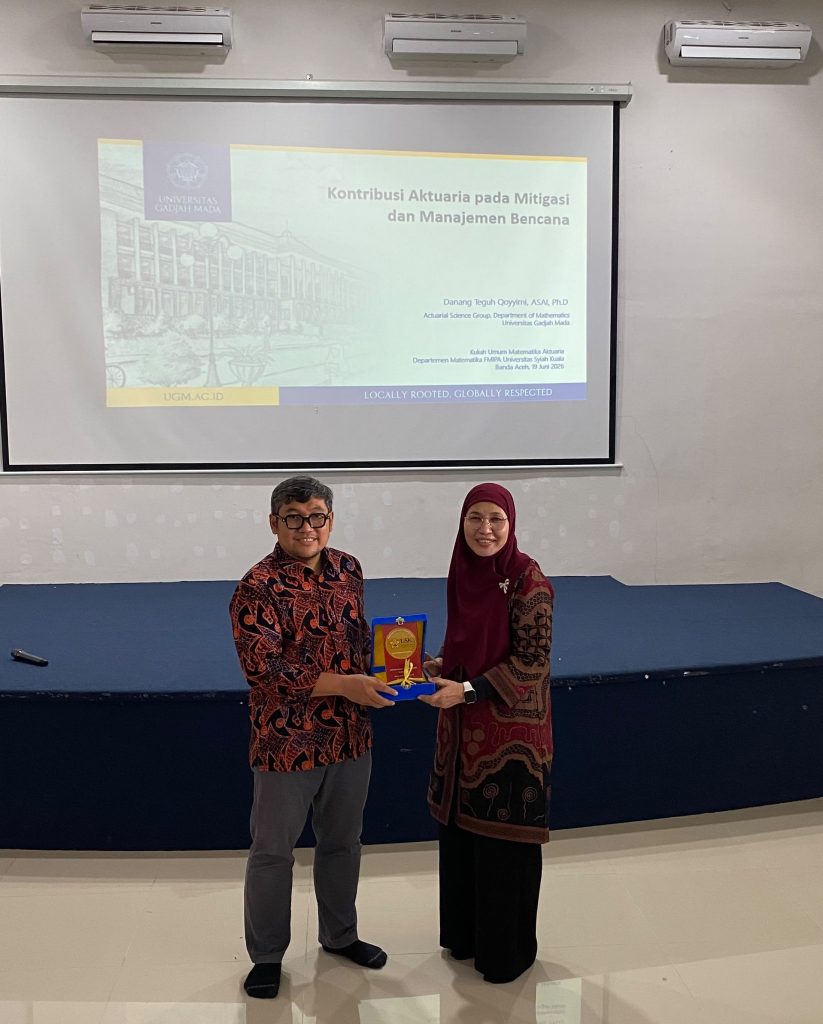

The speaker further explained the concept of catastrophe modelling, which estimates the potential impacts of disasters by integrating several components, including hazard, asset inventory, vulnerability, and loss estimation. As an example, he described earthquake risk modelling based on earthquake rupture points, which often considers geological time horizons extending over tens of thousands of years.
In disaster risk analysis, loss data are first organized into a Stochastic Event Loss Table and subsequently transformed into a Frequency and Severity Table. These datasets are then used to model the frequency and magnitude of losses through probability distributions such as the Negative Binomial Distribution. The resulting models provide a quantitative basis for determining insurance premiums and developing effective disaster risk financing strategies.
In the following session, Dr. Danang presented a case study on disaster risk financing and insurance for government-owned buildings in Padang City. Using a Value at Risk (VaR) optimization approach, he demonstrated how mathematical models can identify the most efficient disaster financing strategies. The study illustrated how local governments can evaluate the optimal combination of risk retention and insurance mechanisms to protect public assets from disaster-related losses.
Toward the end of the lecture, the speaker shared an inspiring message with students and academics about the importance of communication in presenting research findings. According to him, mathematicians should not only be capable of developing rigorous mathematical models but should also be able to communicate their findings effectively to policymakers in language that is clear and accessible.
“Mathematicians must also learn how to communicate. Present what is already served on the dining table, not what is still being prepared in the kitchen.”
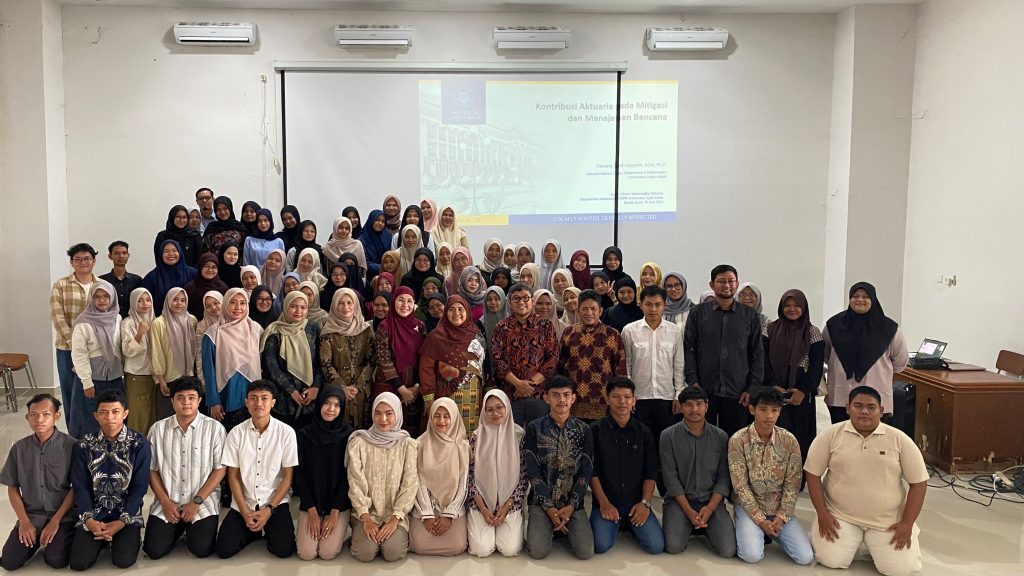
Through this analogy, he emphasized that researchers should avoid overwhelming decision-makers with complex formulas, integrals, or mathematical derivations. Instead, they should focus on presenting practical policy recommendations, possible scenarios, potential impacts, and relevant external considerations, including social and political factors.
This public lecture provided participants with valuable insights into the significant role of mathematics and actuarial science in supporting disaster mitigation and management. It is expected to encourage more interdisciplinary research in actuarial science, risk modelling, and disaster studies, ultimately contributing to the development of more resilient and sustainable disaster risk management systems in Indonesia.